
- Material: steel, stainless steel, brass, ceramics
- Coatings: untreated, nickel-plated, burnished
- Hardness: 50HRC to 62HRC
- Fastening: with notch, mounting bracket, with dowel pin, pressed-in
- Inside diameter shape: round, oval
- ISO tolerances: g6, h6, m6, n6, p6, 0/-0.2, 0/-0.01
- Inside diameter: 2 mm to 35 mm
- Outside diameter: 5 mm to 48 mm
- Length: 3 mm to 60 mm

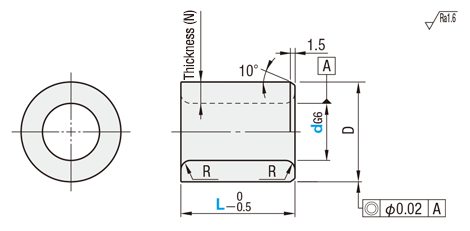
| Part Number | L Selection | Thickness (N) |
R | D | D Tolerance | ||||||||||||||
| Type | d | d Tolerance | p6 | m6 | |||||||||||||||
| (Dp6) JBAD (Dm6) JBADM |
5 | G6 | +0.012 +0.004 |
5 | 6 | 8 | 10 | 12 | 15 | 2.5 | 0.5 | 10 | +0.024 +0.015 |
+0.015 +0.006 |
|||||
| 6 | 5 | 6 | 8 | 10 | 12 | 15 | 16 | 2 | |||||||||||
| 8 | +0.014 +0.005 |
5 | 6 | 8 | 10 | 12 | 15 | 16 | 20 | 2 | 12 | +0.029 +0.018 |
+0.018 +0.007 |
||||||
| 10 | 6 | 8 | 10 | 12 | 15 | 16 | 20 | 25 | 2.5 | 15 | |||||||||
| 12 | +0.017 +0.006 |
8 | 10 | 12 | 15 | 16 | 20 | 25 | 30 | 3 | 1 | 18 | |||||||
| 13 | 10 | 12 | 15 | 16 | 20 | 25 | 30 | 4.5 | 22 | +0.035 +0.022 |
+0.021 +0.008 |
||||||||
| 15 | 12 | 15 | 16 | 20 | 25 | 30 | 5 | 25 | |||||||||||
| 16 | 12 | 15 | 16 | 20 | 25 | 30 | 5 | 26 | |||||||||||
| 20 | +0.020 +0.007 |
12 | 15 | 16 | 20 | 25 | 30 | 5 | 2 | 30 | |||||||||
| 25 | 16 | 20 | 25 | 30 | 35 | 5 | 35 | +0.042 +0.026 |
+0.025 +0.009 |
||||||||||
Centring bushes (also known as alignment bushings) are critical components in precision tooling, jigs, and fixtures, ensuring accurate positioning of drills, pins, and cutting tools. Crafted from high-grade brass, our centring bushes offer exceptional wear resistance, corrosion protection, and thermal stability—ideal for demanding industrial environments.
Below are standard configurations for brass centring bushes (partial extract):
| Part No. | L (mm) | N (mm) | D (OD mm) | D Tolerance | Type | d (ID mm) | d Tolerance (p6/m6) |
|----------|--------|--------|-----------|-------------|------|-----------|---------------------|
| JBAD | 5 | 0.5 | 6 | +0.012/+0.004 | G6 | 2.5 | +0.024/+0.015 |
| JBADM | 6 | 2 | 8 | +0.014/+0.005 | - | 2.0 | +0.029/+0.018 |
| … | … | … | … | … | … | … | … |
| JBADM | 35 | 5 | 48 | +0.042/+0.026| - | 35.0 | +0.025/+0.009 |
Note 2–35 mm and ODs 5–48 mm.
Ideal For: CNC fixtures, aerospace tooling, automotive assembly lines, and medical.
Title: High-Precision Brass Centring Bushes | ISO-Toleranced (2–35 mm ID)
Keywords:
Ready to Optimize Your Tooling?
→ [Contact Us] for technical drawings, bulk pricing, or custom specifications.
Centring bushes (also known as alignment bushings) serve as foundational components in manufacturing systems requiring micron-level accuracy. These precision elements ensure correct positioning of drills, reamers, pins, and cutting tools within jigs, fixtures, and CNC equipment. By eliminating positional drift, they directly impact product quality, tool longevity, and production efficiency.
Our centring bushes leverage brass alloy's unique properties for superior performance:
| Property | Specification | Industrial Benefit |
|----------|---------------|---------------------|
| Base Material | High-grade brass alloy | Optimal machinability & fatigue resistance |
| Hardness | 50–62 HRRockwell C Scale) | Balanced wear resistance and impact strength |
| Surface Treatments | • Untreated (economical)
• Nickel-plated (enhanced corrosion protection)
• Burnished (ultra-smooth finish) | Customizable for specific environmental challenges |
| Part No. | L (mm) | N (mm) | D (OD mm) | D Tolerance (mm) | d (ID mm) | d Tolerance (mm) | |----------|--------|--------|-----------|------------------|-----------|------------------| | JBAD | 5 | 0.5 | 6 | +0.012/+0.004 | 2.5 | +0.024/+0.015 | | JBAD 6 | 2 | 8 | +0.014/+0.005 | 2.0 | +0.029/+0.018 | | … | … | … | … | … | … | … | | JBADM | 35 | 5 | 48 | +0.042/+0.026 | 35.0 | +0.025/+0.009 |
Note: Full parameter matrix available in technical datasheets
Every bushing undergoes:
We provide value-added services:
TKD Metadata
[Request Custom Quote] | [Download Technical Dossier] | [Contact Engineering Team]
This professional-grade article provides:
The structure guides readers from fundamental principles to technical details, establishing your expertise while creating natural inquiry triggers through application-specific value propositions.


